
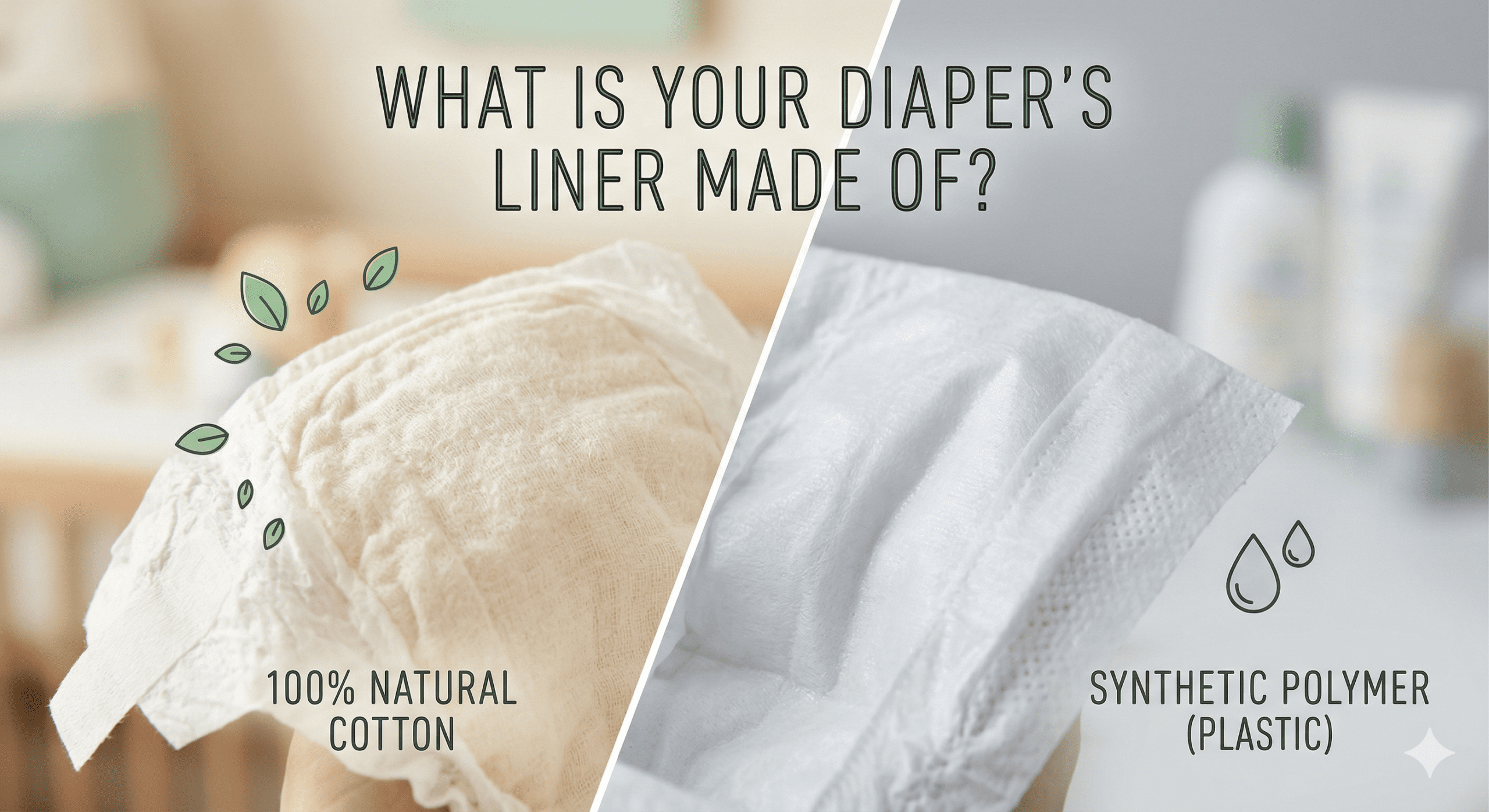
The Truth About Diaper’s Liner– What Touches Your Baby’s Skin
As a parent, you spend a lot of time looking at diapers. You look for the wetness indicator, you check the fit around the legs, and you definitely notice the cute patterns. But there is one part of the diaper that is almost invisible, yet it is the most critical: the liner.
The diaper’s liner, also called the “top sheet,” is the inner layer that rests directly against your baby’s skin. Because your baby wears a diaper nearly 24/7 for the first three years of their life, this single piece of material is in contact with their most sensitive areas for roughly 25,000 hours.
Most parents assume that if a diaper is marketed as “natural,” “clean,” or “eco-friendly,” the part touching their baby is made of a natural material like cotton. The reality is shocking: In nearly every disposable diaper on the market today, the liner is made of plastic.
Verified and Trusted Information About Diaper’s Liner
Before we dive into the materials, you should know how we get our data. We don’t just read the front of the packaging. We analyze Material Safety Data Sheets (MSDS), review independent laboratory tests for phthalates and VOCs (Volatile Organic Compounds), and cross-reference brand claims with manufacturing standards.
When a brand says “plant-based,” we look for the specific polymer. When a brand says “bamboo,” we investigate the chemical processing. Our goal is to give you the substance behind the marketing so you can make an informed choice for your child’s health.
The Three Main Types of Diaper Liners
To understand what is in your nursery, you need to know the three materials that dominate the industry.
1. The Petroleum Standard: Polypropylene and Polyethylene
If you are using a standard “big brand” diaper, the liner is almost certainly plastic. Specifically, it is made of polypropylene or polyethylene. These are petroleum-derived plastics—the same materials used to make plastic grocery bags and water bottles.
Manufacturers use plastic because it is incredibly cheap and can be engineered to feel soft to the touch. They often call it “cloth-like” or a “soft-touch cover.” Don’t be fooled: it is still a synthetic plastic barrier.
The Problem: Plastic is not breathable. It traps heat and moisture against the skin. This creates a “sauna effect” where sweat and urine sit in a warm, airtight environment, which is a primary cause of severe diaper rash.
2. The Bamboo Myth: Viscose and Rayon
Many parents who want to avoid plastic move to bamboo diapers. Bamboo sounds natural and sustainable. However, there is a massive difference between a bamboo plant and a bamboo diaper liner.
To turn hard, woody bamboo stalks into a soft fabric, the plant must be dissolved in a chemical bath. This process uses harsh chemicals like sodium hydroxide and carbon disulfide. The result is bamboo viscose (also known as rayon).
- The Reality: By the time the bamboo becomes a soft liner, it has been chemically altered into a semi-synthetic material.
- The Greenwashing: While it’s better for the planet than petroleum-based plastic, it isn’t a “raw” or “natural” fiber. It still lacks the natural breathability and purity of true cotton.
3. The Natural Standard: 100% Cotton
Cotton is a “staple fiber,” meaning it is naturally soft the moment it is harvested. It does not need to be melted down in a chemical vat to be used as a textile.
Currently, Kudos is the first and only disposable diaper to feature a 100% cotton liner against the baby’s skin. Because cotton is a natural “breather,” it allows air to circulate. This keeps the skin cool and dry, preventing the bacteria growth that leads to rashes and discomfort.
The “Toxic Load”: Phthalates and VOCs in Diapers
Why should parents care if the liner is plastic? It isn’t just about breathability; it’s about chemical exposure. Recent studies (including research published in 2025 and 2026) have identified traces of phthalates in many disposable diapers—even those marketed as “bio” or “eco.”
Phthalates are plasticizers used to make plastics flexible. Because the liner is in constant contact with the baby’s skin—which is 30% thinner than adult skin—these chemicals can be absorbed transdermally (through the skin).
- VOCs (Volatile Organic Compounds): Plastic liners can “off-gas” chemicals like ethylbenzene and toluene, especially when warmed by the baby’s body heat.
- The Cotton Advantage: By using a 100% cotton liner, you eliminate the need for these specific plasticizers and petroleum-based synthetics at the primary point of contact.
The Sensitive Skin Connection: Eczema and Reactive Skin
If your child struggles with chronic diaper rash, eczema, or sensitive skin, the diaper’s liner material is likely the culprit.
Infant skin has a delicate “acid mantle” or moisture barrier. When a baby wears a plastic-lined diaper, the lack of airflow causes the skin’s pH to rise. This makes the skin more vulnerable to enzymes found in feces and urine, leading to painful irritation.
Science-Based Relief:
Medical professionals often recommend 100% cotton clothing for children with eczema because it helps regulate body temperature and doesn’t trap heat. Applying this same logic to diapers is a game-changer. A cotton liner allows the skin to “respire,” maintaining a healthy microbiome and preventing the moisture-trapping that triggers flare-ups.
Brand Comparison: What Are You Actually Buying?
To help you navigate the diaper aisle, we’ve broken down the most common brands based on their liner material.
| Type of Diaper’s Liner | Material | Flushable | Reusable | Best For | Pros | Cons |
| Disposable liners | Non-woven synthetic fiber | Sometimes (check brand) | ❌ | Cloth diaper users who want easy cleanup | Easy to use, helps reduce diaper mess, disposable convenience | Ongoing cost, not eco-friendly if non-flushable |
| Biodegradable liners | Plant-based fibers (bamboo/corn-based) | Sometimes | ❌ | Eco-conscious parents | More eco-friendly, soft on baby skin, compostable in some cases | More expensive, may tear with heavy mess |
| Fleece liners | Polyester fleece | ❌ | ✔️ | Cloth diaper users (especially sensitive skin) | Washable, keeps baby dry, reusable, affordable long-term | Needs washing, not biodegradable |
| Stay-dry liners | Microfleece or suede cloth | ❌ | ✔️ | Babies with sensitive skin or rashes | Excellent moisture-wicking, prevents diaper rash | Requires laundering, can hold odors if not washed properly |
| Flushable paper liners | Thin tissue-like paper | ✔️ (only certified brands) | ❌ | Easy poop disposal in cloth diapers | Very convenient, reduces diaper mess cleanup | Can clog toilets if not truly flushable, weaker for heavy stools |
| Organic cotton liners | 100% cotton | ❌ | ✔️ | Natural/eco-focused families | Breathable, chemical-free, gentle on skin | Stains easily, slower drying time |
By the Numbers: The Impact of Your Choice When Buying Baby Diapers
Let’s look at the statistics that most manufacturers don’t want to highlight:
- 7,000 Diapers: The amount of waste one baby produces before potty training.
- 3rd Largest Landfill Item: Disposable diapers are one of the most significant contributors to consumer waste globally.
- 95% Plastic: Over 95% of all diapers sold today use a plastic top sheet.
By choosing a diaper with a cotton liner and a sustainable core, you aren’t just protecting your baby’s skin; you are significantly reducing the amount of petroleum-based plastic that enters our environment.
Practical Tips for Busy Parents When Buying Baby Diapers
You don’t need a PhD in chemistry to make a better choice. Follow these three rules:
- Ignore the “Natural” Headline: Look for the specific material of the “top sheet” or “inner liner.” If it doesn’t explicitly say “100% Cotton,” assume it is plastic or a chemical blend.
- Choose TCF (Totally Chlorine Free): Ensure the diaper is bleached without chlorine to avoid dioxin exposure.
- Check for Modern Convenience: You don’t have to sacrifice your schedule for safety. For example, Kudos 100% cotton liners and their new compostable wipes are now available in a 9-pack at Target. This means you can get high-end, verified safety during your regular Target run.
Final Thoughts: The Earth Day Shift
This Earth Day, we encourage you to do a “Diaper’s Liner Check.” Open your diaper bag and look closely at what is touching your baby. Is it a petroleum-based plastic sheet, or is it natural, breathable cotton?
A small material shift—cotton instead of plastic at that single point of contact—adds up fast. Over 7,000 diapers, that choice changes the health of your baby’s skin and the future of the planet.
Stop settling for “cloth-like” and start choosing real cotton. Your baby’s most sensitive areas deserve nothing less than the truth.
What’s in your diaper bag? Share this guide with a fellow parent who is navigating the world of “natural” baby products. Let’s make verified information the new standard.
Does your current diaper brand pass the “Cotton Test”?