
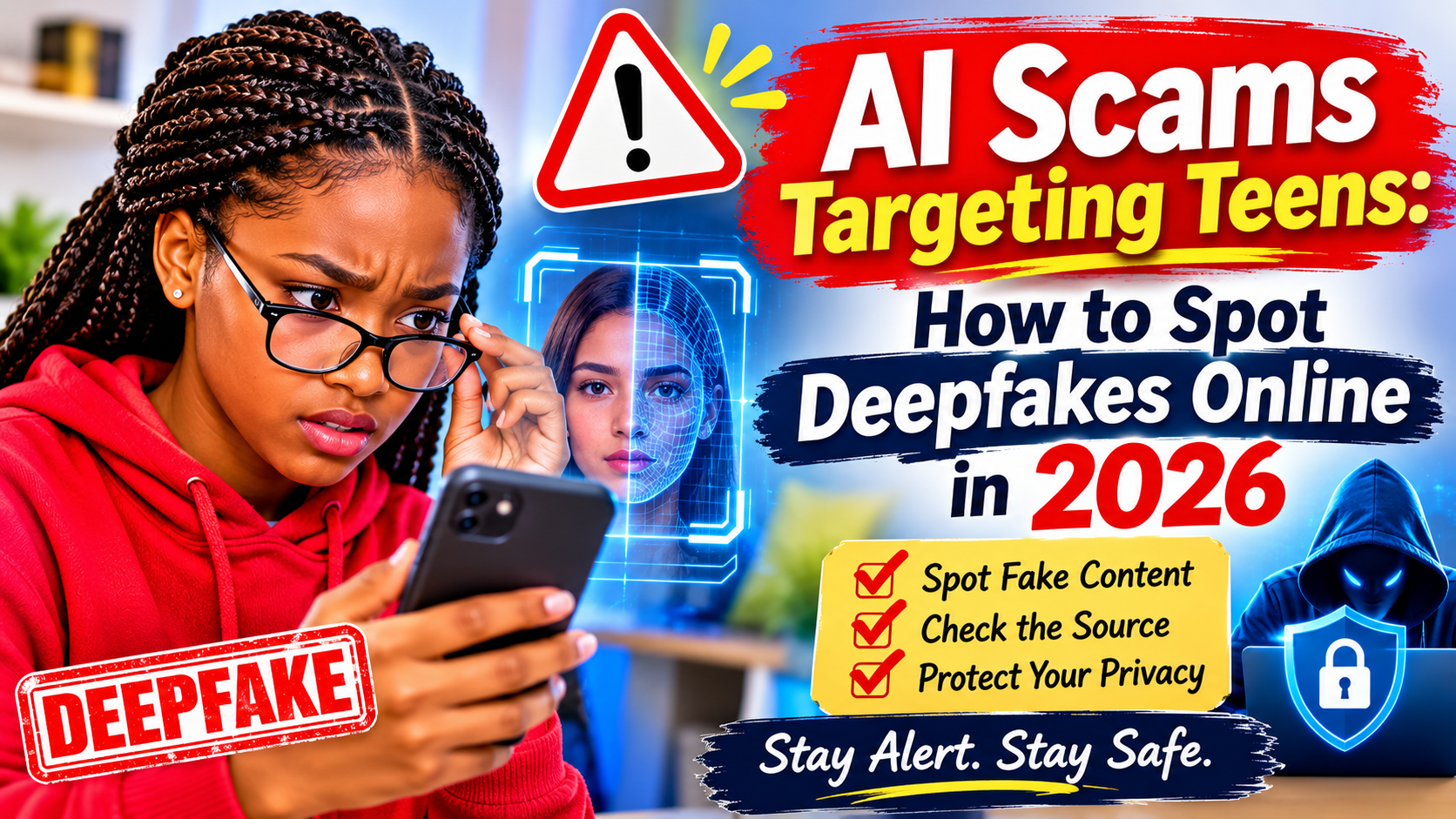
Your teen gets a voice note that sounds exactly like a relative, or a video of a famous businessman promising to turn KSh 1,000 into KSh 10,000. How do you know what is real? AI scams targeting teens are growing fast, but with the right habits, families can stay a step ahead.
Table of Contents
- Why AI Scams Targeting Teens Are Rising in 2026
- What Are Deepfakes and AI Impersonation Scams?
- Real Kenyan Stories: How AI Scams Reach Teens
- 7 Warning Signs of an AI Scam or Deepfake
- How Teens Can Detect Deepfakes: A Simple 5-Step Check
- AI Scams Targeting Teens: Fake Online Jobs and M-Pesa Investment Scams
- Protecting Teen Photos, Voices and Privacy Online
- Create a Family Code Word and Online Safety Agreement
- What to Do If Your Teen Has Been Targeted
- Actionable Takeaways
- Conclusion
Why AI Scams Targeting Teens Are Rising in 2026
Scammers go where young people spend time: TikTok, Instagram, WhatsApp, Snapchat and gaming chats. What has changed is the tools. With a few seconds of audio or a single photo, a criminal can clone a voice, fake a face or write a perfectly polite message. That is why AI scams targeting teens are one of the most important safety topics for families this year.
Consider the numbers. Research published in July 2026 found that 1 in 25 teens reported being a victim of AI-generated deepfake nudes, and 7% had seen such images of other minors. Another 2026 finding suggests only 25% of teenagers feel confident telling real content from AI-made content, down from 46% the year before. In the United States, the FBI recorded 22,364 AI-related complaints and roughly $893 million in reported losses in 2025, and the real figure is probably higher because AI use often goes unnoticed.
Closer to home, Kenya’s KE-CIRT/CC detected more than 4.5 billion cyber-threat events between April and June 2025. That figure covers many kinds of threats, not only deepfakes, but it shows how busy the digital battlefield is for Kenyan families.
The good news? Scams follow patterns. Once your teen knows the patterns, most of them lose their power. As Proverbs 14:15 says, “The simple believe anything, but the prudent give thought to their steps.” Being prudent online is a skill we can teach with love, not fear.
Quick Tip: Teens do not need a lecture about how dangerous the internet is. They need a calm, judgment-free parent who says, “If anything ever feels strange, come to me first, and I will not be angry.”
What Are Deepfakes and AI Impersonation Scams?
A deepfake is a video, image or audio clip created or altered by artificial intelligence to make it look like a real person said or did something they never did. An AI impersonation scam uses that fake to win your trust, then asks for money, passwords or private photos.
The most common types teens meet are:
- Fake celebrity or leader endorsements promoting crypto, betting or “double your money” schemes.
- Cloned voices of a parent, aunt or friend calling in a supposed emergency.
- Fake recruiters offering online jobs, modelling gigs or “easy” side hustles.
- Sextortion using AI-made nude images of a teen, followed by threats and demands.
- Fake giveaways that ask you to “verify” your account by sharing a code.
Kenya has seen real examples. In September 2025, Raila Odinga’s verified X account was compromised to promote a fraudulent “Kenya Token” with a deepfake endorsement. Scammers have also used the likeness of Safaricom CEO Peter Ndegwa in fake M-Pesa investment promotions. If criminals can fake the faces of famous leaders, they can certainly fake a school friend.
Did You Know?: A deepfake does not have to be perfect. It only has to be good enough to fool someone who is rushed, scared or excited.
Real Kenyan Stories: How AI Scams Reach Teens
Here are three realistic situations. They are illustrative examples based on common scam patterns, not reports of specific people.
Story 1: The “Uncle Peter” voice note
Brian, 16, in Nakuru receives a WhatsApp voice note that sounds exactly like his uncle: “I am stuck at the hospital, please send KSh 5,000 on M-Pesa right now, do not tell your mum.” The voice is a clone built from a social media video. Because of the secrecy and urgency, Brian pauses and calls his uncle on his normal number. His uncle is at work, perfectly fine. Crisis avoided.
Story 2: The “AI interview” job
Wanjiru, 17, in Kisumu is told she has been shortlisted for a remote data-entry job after a slick video interview. The recruiter looks professional, then asks for a KSh 1,500 “registration fee.” No genuine employer asks a teen to pay to work. She shows her father, who checks the company online and finds nothing. They report the number.
Story 3: The fake investment star
Kevin, 15, in Mombasa sees a video of a famous businessman promising that KSh 1,000 will turn into KSh 10,000 in one day. The lips do not quite match the words. Kevin remembers his family’s rule: if it promises quick riches, we check first. He forwards it to his mother, and they learn it is a known scam.
Quick Tip: In all three stories, the teen was protected not by technology but by a habit: pause, verify, tell someone.
7 Warning Signs of an AI Scam or Deepfake
No single sign proves a fake, and AI improves every month, so never rely on appearance alone. But these red flags are worth teaching:
- Urgency. “Do it now or something bad will happen.”
- Secrecy. “Do not tell your parents.” Real emergencies rarely need secrets.
- Requests for money or codes through M-Pesa, gift cards or crypto, especially from someone who suddenly changed numbers.
- Too good to be true. Guaranteed profits, free phones, easy jobs with huge pay.
- Visual glitches. Distorted hands, odd lighting, blurry teeth or ears, lips that do not match the audio.
- Flat or robotic voices, strange pauses or the wrong way of speaking for that person.
- Payment before work. Any job that asks you to pay a fee first is a scam.
The first two signs matter most. Scammers want your emotions to move faster than your thinking. Your best defence is simply slowing down.
Quick Tip: Teach the three-word rule: Stop. Check. Tell. Stop before reacting, check through another channel, and tell a trusted adult.
How Teens Can Detect Deepfakes: A Simple 5-Step Check
Here is a routine your teen can run in under two minutes. It works for videos, voice notes, photos and messages.
- Pause. Take three slow breaths. Do not reply, click or send anything.
- Look and listen closely. Check faces, hands, lighting, lip movement and voice tone.
- Verify the source. Is this from an official, verified account? Search the claim on a trusted news site.
- Contact the person directly. Call them on a number you already have, never the number in the message.
- Tell an adult. A second pair of eyes catches what we miss when we are anxious.
Real people can also be wrongly accused of using AI, and fakes can look perfect. That is why verification through a trusted channel beats guessing from pixels.
Quick Tip: Reverse image search tools can help you check whether a photo has appeared elsewhere, but treat the result as a clue, not proof.
AI Scams Targeting Teens: Fake Online Jobs and M-Pesa Investment Scams
Many Kenyan teenagers want to earn money, which is a wonderful, responsible desire. Scammers know this and exploit it with fake online jobs and M-Pesa investment schemes. Teens who want honest ways to earn can explore making money online, but only after learning these safety rules.
- Never pay to get a job. Legitimate employers do not charge registration, training or “security” fees.
- Verify the company. Look for a real website, registered business details and independent reviews.
- Do not trust a professional-looking interview. AI can make a recruiter look and sound credible.
- Avoid “double your money” offers. Real investments carry risk and never guarantee quick profit.
- Never share your M-Pesa PIN or OTP codes. Safaricom will never ask for them.
- Involve a parent before sending any money, even small amounts.
Proverbs 13:11 reminds us, “Dishonest money dwindles away, but whoever gathers money little by little makes it grow.” Slow, honest work beats a shortcut every time.
Quick Tip: If an opportunity pressures you to decide today, that pressure itself is your answer. Real opportunities can wait while you ask questions.
Protecting Teen Photos, Voices and Privacy Online
Deepfakes need raw material: photos, videos and voice recordings. The less public material exists, the harder it is to misuse. Walk through these steps together with your teen:
- Set accounts to private and accept only people they know in real life.
- Limit public photos and videos, especially in school uniform, with school names or with home locations visible.
- Turn off location tagging on posts and photos.
- Use strong, different passwords and switch on two-step verification.
- Never send private photos, even to someone they trust. Images can be copied, altered and shared.
- Think before posting voice clips. A few seconds can be enough to clone a voice.
Be gentle in how you present this. The goal is not to shut your child out of social media, but to help them stay in control of their image and dignity. Every person is made in God’s image (Genesis 1:27), and that includes protecting it online.
Quick Tip: Review privacy settings together once every three months. Make it a relaxed Sunday-afternoon chat with snacks, not an inspection.
Create a Family Code Word and Online Safety Agreement
One of the simplest tools against voice-cloning scams is a private family code word. Choose a word or phrase only your family knows, such as a favourite childhood dish or a funny family memory. If anyone calls or messages asking for urgent help or money, they must give the code word. No code word, no money.
Pair this with a short family online safety agreement:
- We pause before reacting to urgent messages.
- We verify through a known number before sending money.
- We never keep online secrets that make us feel scared or ashamed.
- Mum and Dad promise to respond with calm, not punishment, when we report something.
- We pray for one another and talk openly about what we see online.
That fourth promise is the heart of it. Many teens stay silent after being scammed or threatened because they fear punishment. Silence is what scammers depend on.
Did You Know?: Write the agreement together, let your teen add their own rules, and have everyone sign it. Ownership makes teens far more likely to follow it.
What to Do If Your Teen Has Been Targeted
If your child has been scammed, threatened or had a fake image made of them, how you respond in the first hour matters enormously.
- Stay calm and reassure them. Say clearly: “You are not in trouble. I am proud you told me. We will handle this together.”
- Do not pay or reply to blackmail or threats.
- Save evidence. Take screenshots of messages, usernames, links and payment details.
- Block the sender and report the account to the platform.
- Contact your mobile provider immediately if money was sent through M-Pesa.
- Report to the authorities, such as the Directorate of Criminal Investigations (DCI) in Kenya, especially if intimate images of a minor are involved.
- Offer emotional support. Consider a trusted counsellor, pastor or school guidance teacher if your teen feels shame or anxiety.
Remind your child that being tricked says nothing about their intelligence or character. These tools are built to fool adults, banks and experts too.
Quick Tip: Never blame the victim. A teen who feels safe telling you about one scam will tell you about the next one sooner.
Actionable Takeaways: Your Teen Safety Checklist
- Teach Stop. Check. Tell. to every teen in your home.
- Choose a family code word this week.
- Review privacy settings on every social account.
- Agree that no one ever pays to get a job.
- Promise a calm, no-punishment response when your teen reports a problem.
- Save evidence, block, report and involve a trusted adult if something goes wrong.
Conclusion: Raising Wise, Confident Digital Natives
Technology will keep changing, but wisdom, honesty and open family conversation never go out of date. When we pair practical online safety habits with unconditional love and faith, our teens can enjoy the internet without being ruled by fear. Let us pray for our children, walk beside them, and trust that God gives wisdom to those who ask (James 1:5).
Found this helpful? Save this post, share it with another parent or teen, and subscribe to Kiddos Blog for more practical, faith-friendly guidance for your family every day.