
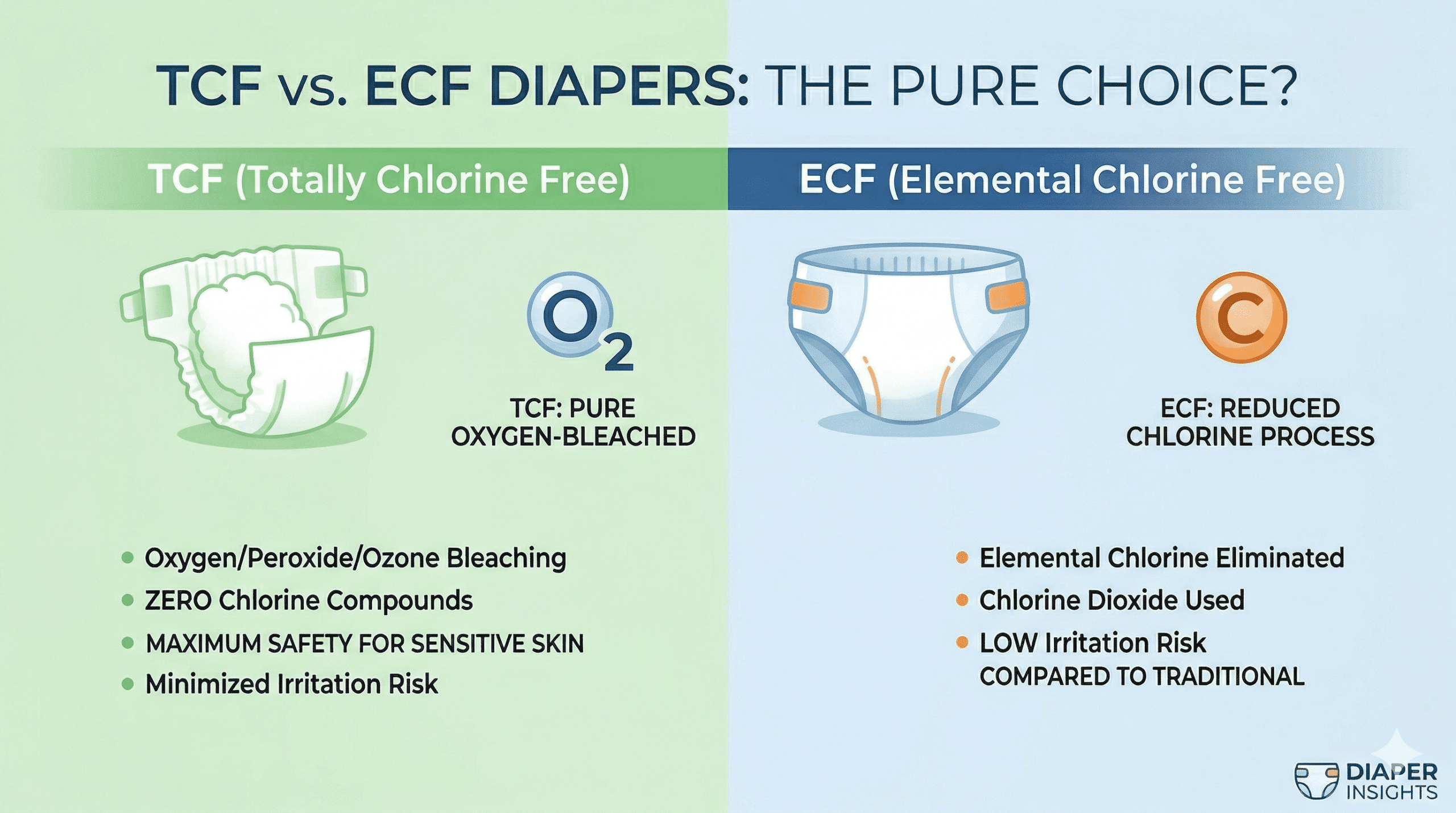
Parents searching for chlorine-free diapers quickly run into confusing labels: TCF, ECF, “chlorine-free,” “no harsh chemicals,” and “pure pulp.” These labels sound similar, but they do not mean the same thing. Understanding the difference between Totally Chlorine Free (TCF) and Elemental Chlorine Free (ECF) diapers can help you make a better decision, especially if your baby has sensitive skin, eczema, or persistent diaper rash.
This guide explains the TCF vs. ECF diaper difference, the bleaching process, whether chlorine-free diapers are safer for babies, and what actually matters most for preventing diaper rash.
Why Diapers Are Bleached in the First Place
Most disposable diapers contain an absorbent core made from wood pulp and superabsorbent polymer (SAP). Raw wood pulp is naturally brown. Manufacturers bleach it to:
- Remove natural lignin and impurities
- Improve absorbency consistency
- Make the diaper look clean and white
- Reduce odor
The issue is not the bleaching itself — it’s what chemicals are used during bleaching and what byproducts may be left behind.
This is where TCF vs. ECF diapers come in.
What Are TCF Diapers?
TCF stands for Totally Chlorine Free. This means no chlorine and no chlorine compounds are used during the bleaching process.
Instead, TCF bleaching uses:
- Oxygen
- Ozone
- Hydrogen Peroxide
These methods whiten the pulp without producing chlorine-based toxic byproducts.
Key Features of TCF Diapers
- No chlorine used at any stage
- No chlorine byproducts
- Lower environmental pollution
- Typically used in eco-friendly diapers
- Usually more expensive
TCF is considered the cleanest bleaching method from an environmental and chemical processing standpoint.
What Are ECF Diapers?
ECF stands for Elemental Chlorine Free. This is where many parents misunderstand the label.
Elemental chlorine gas is not used, but chlorine compounds are still used, typically chlorine dioxide.
This method replaced older chlorine bleaching methods that produced high levels of toxic compounds called dioxins.
One of the main concerns historically associated with chlorine bleaching is the formation of Dioxins, which are persistent environmental toxins.
Modern ECF processes greatly reduce dioxins, but do not eliminate them to the same extent as TCF.
Key Features of ECF Diapers
- No chlorine gas used
- Chlorine compounds used
- Very low dioxin levels
- Most common bleaching method worldwide
- More affordable than TCF
TCF vs. ECF Diapers: Side-by-Side Comparison
| Feature | TCF | ECF |
| Chlorine used | No | Yes (chlorine compounds) |
| Dioxin production | Essentially zero | Very low |
| Environmental impact | Lower | Moderate |
| Cost | Higher | Lower |
| Availability | Less common | Very common |
| Considered safe for babies | Yes | Yes |
This leads to an important conclusion:
Both TCF and ECF diapers are considered safe for babies.
The difference is primarily environmental and chemical-processing related, not immediate toxicity.
However, for babies with very sensitive skin, the difference can still matter.
Sensitive Skin, Eczema, and Skin Barrier Damage
Babies with eczema or chronic diaper rash often have a compromised skin barrier. When the skin barrier is damaged, the skin loses moisture faster and becomes more reactive to irritants. This process is known as Transepidermal Water Loss (TEWL).
When TEWL increases:
- Skin becomes dry and inflamed
- Irritants penetrate more easily
- Friction causes more damage
- Even small chemical residues can trigger irritation
This is why babies with Eczema, chronic diaper rash, or Contact Dermatitis may react to things that don’t affect other babies.
Does This Mean ECF Diapers Cause Rashes?
No. Modern ECF diapers are considered safe. But babies with damaged skin barriers may tolerate TCF diapers better because they involve less chemical processing overall.
So the difference is not “safe vs unsafe.”
It is “less processed vs more processed.”
The Role of Dioxins in the TCF vs. ECF Debate
Historically, chlorine bleaching produced dangerous levels of dioxins. Modern ECF bleaching significantly reduced these emissions, and the levels found in modern products are extremely low.
Important clarification:
- Dioxins are primarily an environmental concern
- Modern diapers do not contain harmful levels of dioxins touching your baby’s skin
- The main concern is long-term environmental accumulation, not immediate skin burns or rashes
This is why many environmental organizations prefer TCF bleaching, even though ECF products are considered safe for use.
What Actually Causes Diaper Rash (More Important Than Bleaching Method)
Many parents focus heavily on chlorine-free labels, but dermatology research consistently shows the main causes of diaper rash are:
- Moisture
- Friction
- Increased skin pH
- Enzymes in urine and stool
- Skin barrier damage
- Yeast overgrowth
- Infrequent diaper changes
- Tight diapers causing rubbing
Notice something important:
Bleaching method is not one of the top causes of diaper rash.
This means switching from ECF to TCF diapers may help some babies, but it will not fix diaper rash if the real cause is:
- Friction
- Moisture
- Poor diaper fit
- Yeast infection
- Damaged skin barrier
Bleaching method is a secondary factor, not the primary cause in most diaper rash cases.
When TCF Diapers Make the Biggest Difference
TCF diapers may be worth it if your baby has:
- Eczema
- Chronic diaper rash
- Allergic contact dermatitis
- Very reactive skin
- Skin barrier damage
- Frequent redness without clear cause
These babies often have higher TEWL, meaning their skin allows more irritants to pass through. Reducing overall chemical exposure — even small amounts — can make a difference.
When ECF Diapers Are Completely Fine
ECF diapers are usually fine if:
- Your baby has normal skin
- Your baby rarely gets rashes
- You change diapers frequently
- The diaper fits properly
- You use barrier cream when needed
In fact, most diapers sold worldwide are ECF, and millions of babies use them without any issues.
Environmental Impact: TCF vs. ECF
If environmental impact matters to you, this is where the biggest difference exists.
ECF Bleaching:
- Uses chlorine compounds
- Produces some chemical waste
- Requires wastewater treatment
- Small dioxin byproducts
TCF Bleaching:
- Uses oxygen/peroxide
- Produces fewer toxic byproducts
- Lower water pollution
- Preferred for eco-friendly manufacturing
So from an environmental standpoint:
TCF is better for the environment.
From a baby safety standpoint:
Both TCF and ECF are considered safe.
Are Chlorine-Free Diapers Worth It?
This depends on your priorities.
| Priority | Best Choice |
| Lowest chemical processing | TCF |
| Sensitive skin | TCF |
| Eczema | TCF |
| Environmental impact | TCF |
| Budget | ECF |
| Availability | ECF |
| Normal skin | ECF |
So the decision is not about good vs bad, but about:
- Budget
- Skin sensitivity
- Environmental values
Marketing Terms Parents Should Not Confuse
Many diaper packages use terms that sound similar but mean different things:
| Label | What It Actually Means |
| Chlorine Free | Usually ECF |
| Totally Chlorine Free | TCF |
| Elemental Chlorine Free | ECF |
| Unbleached | Pulp not whitened |
| Hypoallergenic | No common irritants (not regulated) |
| Fragrance Free | No added perfume |
The term “chlorine-free” alone usually means ECF, not TCF.
If you want truly chlorine-free bleaching, the package must say Totally Chlorine Free (TCF).
How to Choose the Right Diaper for Sensitive Skin
If your baby has sensitive skin, the most important factors are:
- Fit – prevents friction
- Absorbency – keeps skin dry
- Breathability – reduces heat and moisture
- Fragrance-free – reduces irritation
- Lotion-free inner liner – reduces reactions
- Barrier cream use – protects skin
- Bleaching method (TCF vs ECF) – secondary but helpful
Many persistent diaper rashes are actually caused by friction and moisture, not chemicals. So even the cleanest TCF diaper can still cause rash if:
- It’s too tight
- It rubs the thighs
- It stays wet too long
Final Verdict: TCF vs. ECF Diapers
Here is the most accurate, research-based conclusion:
- TCF diapers use no chlorine, produce fewer environmental pollutants, and may be better for babies with eczema or extremely sensitive skin.
- ECF diapers use chlorine compounds but are still considered safe and are the most common diapers available.
- The biggest causes of diaper rash are moisture, friction, and skin barrier damage, not chlorine bleaching.
- Choosing between TCF and ECF is more about environmental impact and skin sensitivity, not basic safety.
Simple Summary
- If your baby has eczema or chronic diaper rash → Try TCF
- If your baby has normal skin → ECF is fine
- If your priority is environment → Choose TCF
- If your priority is budget → Choose ECF
ALSO READ: The Truth About Bamboo Diapers: Is Your “Natural” Diaper Just Processed Rayon?