
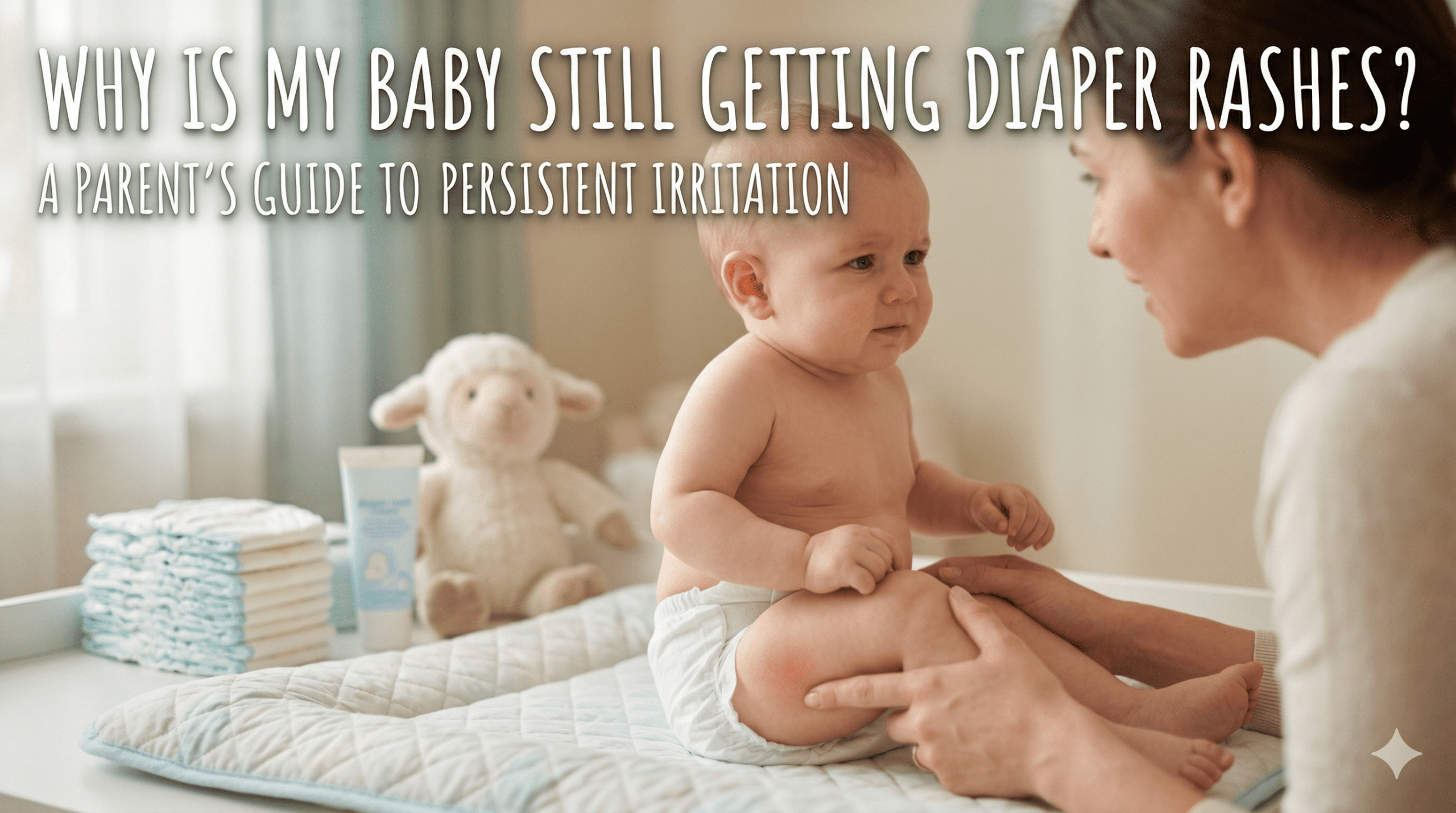
Are these Diaper Rashes from Friction or Chemical Sensitivity?
If you’ve tried “sensitive” diapers, fragrance-free wipes, rash creams, and your baby still keeps getting diaper rashes, you’re not alone. Many parents assume persistent diaper rash is caused by an allergy or a reaction to diaper materials — but in many cases, the real cause is something completely different: friction and skin barrier damage, not chemicals.
Understanding the difference between mechanical friction and chemical sensitivity is the key to finally solving persistent diaper rash.
The Real Science Behind Persistent Diaper Rash: TEWL
To understand why some diaper rashes won’t go away, you need to understand a skin concept called Transepidermal Water Loss (TEWL).
TEWL is the amount of water that passively evaporates through the skin. Healthy skin keeps moisture in and irritants out. But when the skin barrier is damaged, water escapes faster, and irritants can penetrate the skin more easily — leading to redness, inflammation, and rash.
At the center of this is the Stratum Corneum, the outermost layer of the skin. Think of it like a brick wall:
- Skin cells = bricks
- Natural oils = mortar
When the “mortar” is damaged, the wall becomes weak. Moisture escapes, and the skin becomes irritated very quickly.
This is why some diaper rashes seem impossible to cure — you’re treating the rash, but not fixing the skin barrier.
Friction Rash vs. Chemical Rash: What’s the Difference?
Many parents think:
“My baby must be allergic to this diaper.”
But true diaper allergies are actually rare. What’s much more common is mechanical friction caused by a diaper that doesn’t fit correctly.
Here’s how each type of rash works:
1. Mechanical Friction Rash (Most Common Cause)
This happens when a diaper:
- Is too tight
- Is too loose and rubs
- Has elastic that repeatedly rubs the skin
- Moves around during sleep or crawling
This rubbing damages the stratum corneum, increases TEWL, and the skin becomes red and raw.
Signs of friction rash:
- Redness only where elastic touches
- Red lines around thighs or waist
- Rash in inner thighs, not the whole diaper area
- Rash improves when diaper is removed and baby has diaper-free time
This is not an allergy. It’s a skin barrier injury.
2. Chemical Contact Dermatitis (Sensitivity Reaction)
This happens when the skin reacts to:
- Fragrances
- Lotions in diapers
- Wipes
- Detergent
- Diaper dyes
- Rash creams with certain ingredients
Signs of chemical rash:
- Redness everywhere the diaper touches
- Rash on buttocks, genitals, and hips
- Skin may look shiny or have small bumps
- Rash does not match elastic lines
- Rash may worsen quickly after a new diaper brand or wipes
This is called Contact Dermatitis.
The “Press Test”: How to Tell What’s Causing the Rash
Here is a simple test you can do at home that many parents have never heard of — but pediatric dermatology nurses use it often.
How to Do the Press Test
- Remove the diaper.
- Look at where the redness is.
- Gently press along the diaper elastic lines (thigh and waist).
- Compare the elastic areas vs the areas covered by the diaper padding.
Results:
- Redness only where elastic touches → Friction Rash
- Redness everywhere diaper touches → Chemical Contact Dermatitis
This simple test can immediately tell you whether you need:
- A better fitting diaper
- Or a different diaper material
Why “Sensitive” Diapers Don’t Fix Friction Rashes
This is important: Sensitive diapers only reduce chemical irritation. They do NOT reduce friction if the fit is wrong.
If a diaper:
- Slides
- Twists
- Leaves deep marks
- Has tight elastic
- Is the wrong shape for your baby’s thighs
…it will continue to damage the skin barrier no matter how “sensitive” it is.
So if you switched to sensitive diapers and the rash is still there, the problem may be fit, not ingredients.
How to Fix a Friction Diaper Rash (Barrier Repair Plan)
If the rash is caused by friction, the goal is to repair the skin barrier and reduce TEWL.
Here’s what works:
Step 1: Increase Diaper-Free Time
Air exposure reduces moisture and friction.
Step 2: Use a Thick Barrier Cream
Look for creams with:
- Zinc oxide
- Petrolatum
- Lanolin
These reduce TEWL and protect the stratum corneum while it heals.
Step 3: Change Diaper Size or Brand
A different brand may:
- Fit wider
- Fit narrower
- Have different elastic placement
- Cause less rubbing
Step 4: Make Sure the Diaper Isn’t Too Tight
You should be able to fit two fingers under the waistband.
Step 5: Change Diapers Frequently
Less moisture = less friction damage.
How to Fix a Chemical Diaper Rash
If the rash is contact dermatitis, you need to remove the irritant:
- Switch to fragrance-free diapers
- Use cotton pads + warm water instead of wipes
- Wash cloth diapers with fragrance-free detergent
- Avoid creams with:
- Fragrance
- Essential oils
- Preservatives like MI/MCI
Healing usually starts within 2–4 days once the irritant is removed.
When to See a Doctor
See a pediatrician if:
- Rash has open wounds
- Rash is bleeding
- Rash has yellow crusts
- Rash spreads beyond diaper area
- Rash lasts more than 7 days
- You see bright red rash with small red dots (could be yeast)
Yeast diaper rash is often caused by Candida Diaper Rash, which requires antifungal treatment — not just barrier cream.
The Most Important Thing Parents Should Remember
If your baby’s diaper rash keeps coming back, ask this question first:
Is this a skin reaction — or is this skin damage?
Because:
- Skin reaction = chemical
- Skin damage = friction
And the treatments are completely different.
Once you identify the true cause using the Press Test, you can finally treat the rash correctly — and most persistent diaper rashes improve very quickly once the real cause is addressed.
Quick Summary
| Symptom | Cause | Solution |
| Redness at elastic lines | Friction | Change diaper fit + barrier cream |
| Redness everywhere diaper touches | Chemical | Switch to fragrance-free products |
| Bright red with dots | Yeast | Antifungal cream |
| Rash won’t heal | Skin barrier damage | Reduce TEWL + thick barrier cream |
Final Thought
Most persistent diaper rashes are not because you chose the wrong diaper brand.
They happen because the skin barrier is damaged, and until that barrier heals, every diaper will continue to irritate the skin — even the most sensitive one.
Fix the skin barrier, reduce friction, lower TEWL, and the rash cycle usually stops.
And that’s the part most diaper rash advice never explains.
Also Read: Top 10 Hypoallergenic Overnight Diapers for Sensitive Skin